
Updated: November 2026 · Estimated reading time: 10 minutes
The way people search for information online is undergoing one of its biggest transformations in decades. Traditional search engines are no longer the only destination for discovering products, comparing services, or finding answers. AI-powered platforms such as ChatGPT, Google AI Overviews, Google AI Mode, and Perplexity are changing how users interact with information.
Instead of browsing through multiple websites, users can now ask complex questions and receive synthesized answers within seconds. For businesses, this shift raises an important question: How can you make your website visible not only in traditional Google search results but also in AI-generated answers?
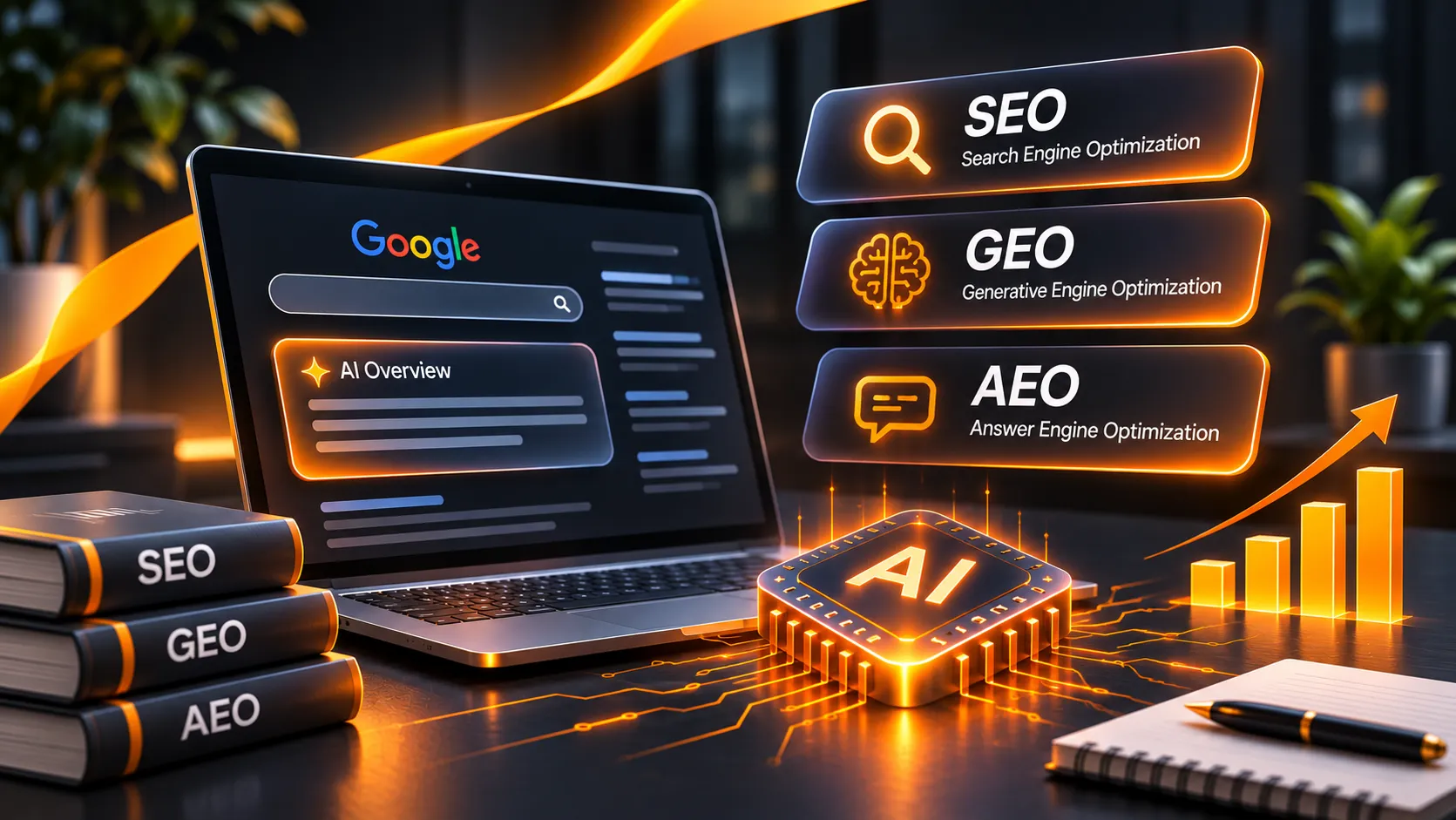
This is where three increasingly important concepts come into play: Search Engine Optimization (SEO), Generative Engine Optimization (GEO), and Answer Engine Optimization (AEO). In this guide, we'll explain their differences, explore how AI search works, and share practical strategies to help businesses improve their online visibility in 2026 and beyond.
🤖 What Is AI Search Optimization?
AI search optimization refers to the process of improving a website's content, technical accessibility, and digital presence to increase its chances of being discovered, understood, and referenced by AI-powered search systems. Traditional SEO focuses on helping websites appear in search engine results. AI search optimization expands that objective by considering how AI-powered systems retrieve information, synthesize answers, and select sources.
For example, imagine someone searches for: "What is the best e-commerce platform for a small business with a limited budget?" A traditional search engine might display a list of articles comparing Shopify, WooCommerce, and other platforms. An AI-powered search experience may instead summarize the advantages and limitations of each option, explain which businesses they suit, and provide links to supporting sources.
For website owners, the opportunity is clear: publishing helpful, credible, and accessible content can create additional ways for potential customers to discover their brands. However, no optimization technique can guarantee that a particular website will be cited or recommended by an AI system.
📈 Why AI Search Optimization Matters in 2026
AI-powered search is no longer an experimental concept. In August 2026, Google reported that AI Overviews had surpassed 2.5 billion monthly active users, while AI Mode had exceeded one billion monthly users. These figures demonstrate the scale of AI-assisted discovery within the Google ecosystem.
At the same time, marketing professionals are increasingly discussing new approaches to search visibility, including GEO and AEO. This shift creates three important challenges for businesses.
1. Search behavior is becoming more conversational
Users increasingly ask detailed, context-rich questions instead of relying exclusively on short keyword phrases. For example:
- Traditional query: "Best CRM software"
- Conversational query: "Which CRM software is best for a small marketing agency that needs automation, affordable pricing, and integrations with Google Workspace?"
The second query contains more information about the user's needs, making it valuable for businesses that publish detailed comparisons and practical recommendations.
2. Visibility is no longer limited to traditional rankings
A brand may be discovered through a standard search result, an AI-generated response, a product comparison, or a conversational recommendation. These experiences do not necessarily follow the same ranking or citation mechanisms. Consequently, businesses need to consider a broader range of discovery channels.
3. Content quality and differentiation matter
Generic content has become easier to produce at scale. Businesses can differentiate themselves by publishing firsthand experiences, original research, expert analysis, transparent methodologies, and useful information that competitors have not already covered. Google's official 2026 guidance emphasizes the value of unique, helpful, and non-commodity content for generative AI search.
⚖️ SEO vs. GEO vs. AEO: What's the Difference?
Although these terms are closely related, they describe different areas of search optimization.
| Strategy | Full Name | Main Focus |
|---|---|---|
| SEO | Search Engine Optimization | Improving visibility in traditional search results |
| GEO | Generative Engine Optimization | Increasing opportunities for visibility and citations in generative AI responses |
| AEO | Answer Engine Optimization | Helping users and answer systems find clear, direct answers |
What Is SEO?
Search Engine Optimization is the practice of improving a website's technical performance, content quality, accessibility, and relevance to organic search queries. Common SEO activities include keyword research and search intent analysis, technical SEO audits, on-page content optimization, internal linking, improving page experience, building a credible online reputation, and monitoring organic search performance. SEO remains essential because many AI-powered search features, including Google's AI experiences, rely on existing search infrastructure and quality systems.
What Is GEO?
Generative Engine Optimization focuses on improving the likelihood that AI-powered systems will discover, use, mention, or cite information associated with a website or brand. GEO strategies often emphasize original expertise, accurate information, clear explanations, reliable sources, and consistent brand information. For example, a cybersecurity company might publish an original report comparing security vulnerabilities across several software categories. If that report contains useful, well-supported findings, it may become a valuable reference for users and systems answering related questions.
However, GEO is still an evolving discipline. Its terminology, measurement methods, and best practices are not universally standardized. It is also important to distinguish legitimate content improvements from unproven claims about guaranteed AI recommendations.
What Is AEO?
Answer Engine Optimization focuses on making information easy to find, interpret, and present as a direct answer to a user's question. For example, consider the question: "What is the difference between SEO and GEO?" An answer-focused paragraph could begin: "SEO improves a website's visibility in search engine results, while GEO focuses on increasing its visibility and likelihood of being referenced in generative AI responses." The article could then expand on that explanation with examples, comparisons, and practical advice. This approach improves readability and helps users reach relevant information quickly.
Do GEO and AEO Replace Traditional SEO?
No. The most effective approach is to treat SEO as the foundation while using relevant GEO and AEO principles to improve the usefulness and accessibility of content. In its official guidance, Google states that websites do not need special AI-specific markup or entirely different optimization techniques to become eligible for AI Overviews or AI Mode. Strong technical SEO and helpful, reliable content remain central.
🔍 How Do AI Search Engines Find and Use Content?
AI-powered search systems can use several techniques to produce responses. One important approach is Retrieval-Augmented Generation (RAG). RAG allows a generative model to use retrieved information from external sources when constructing a response. In simplified terms, the process may involve:
- Understanding the user's question and identifying relevant information needs.
- Retrieving potentially useful sources through a search or retrieval system.
- Evaluating and processing information from those sources.
- Generating a response that addresses the user's question.
- Providing references or supporting links when the product supports them.
Not every AI platform uses the same architecture, and individual results can vary depending on the query, retrieval system, model, and available information. For Google AI search experiences, traditional search indexing and quality systems remain particularly important. This means website owners should prioritize making their pages accessible, indexable, accurate, and useful.
🚀 10 Practical AI Search Optimization Strategies for 2026
1 Publish Original, Experience-Based Content
One of the strongest ways to differentiate a website is to provide information that cannot easily be replicated from generic summaries. Consider two articles about choosing an e-commerce platform. The first simply lists the advantages of popular platforms. The second compares actual implementation costs, discusses technical limitations, shares migration challenges, and explains which solutions worked in real projects.
The second article provides more distinctive value. Businesses should consider publishing:
- Original case studies
- Firsthand product evaluations
- Expert interviews
- Real implementation examples
- Documented research findings
- Transparent comparisons
Originality alone does not guarantee visibility, but it gives audiences a stronger reason to trust and reference the content.
2 Answer Questions Clearly and Directly
Use descriptive headings that reflect the questions your audience asks. For example: How long does SEO take to show results? A useful answer might explain that SEO timelines vary depending on competition, website history, technical condition, content quality, and the work being performed. The article can then explore these factors in detail.
Avoid unnecessarily lengthy introductions before providing the information readers came to find. However, do not sacrifice completeness simply to make every answer extremely short.
3 Strengthen Experience, Expertise, Authoritativeness, and Trustworthiness
Google discusses these qualities through its E-E-A-T framework. Although E-E-A-T is not a single numerical ranking score, its principles provide useful guidance for building credible content. Ways to strengthen trust include:
- Identifying qualified authors and reviewers
- Publishing genuine customer experiences
- Referencing credible research
- Explaining how conclusions were reached
- Providing accurate company information
- Correcting outdated or misleading claims
For technical topics, expert review can be especially valuable.
4 Maintain Strong Technical SEO
AI search optimization cannot compensate for major technical problems that prevent search systems from accessing relevant pages. Important technical checks include:
- Crawlability: Ensure important pages are accessible to intended search crawlers.
- Indexability: Confirm pages are eligible for indexing and are not accidentally blocked by noindex directives.
- Canonicalization: Use appropriate canonical signals to reduce confusion between duplicate or similar URLs.
- Internal linking: Provide discoverable paths to important content.
- JavaScript rendering: Ensure critical information is available to search engines even when a website relies heavily on client-side rendering.
- Mobile usability: Make content accessible and usable on smaller screens.
- Page performance: Reduce unnecessary delays and improve the browsing experience.
Google confirms that being indexed and eligible to appear with a snippet is part of the technical eligibility requirements for supporting links in its AI search features.
5 Use Structured Data Correctly
Structured data helps search engines understand specific information about web pages. Depending on the content, useful schema types may include Article, BlogPosting, Product, Organization, and BreadcrumbList. For example, a blog article may include structured information about its headline, author, publication date, and featured image.
However, structured data must accurately reflect the visible page content. It is also important to avoid a common misconception: there is no special schema markup that guarantees visibility in Google's AI Overviews or AI Mode. Structured data remains valuable for established search features, but it should not be marketed as a shortcut to AI citations.
6 Build Topical Depth Through Content Clusters
Rather than publishing unrelated articles, organize content around subjects directly relevant to your business. For example, a digital marketing agency might create a comprehensive guide to SEO supported by specialized articles covering technical SEO, keyword research, local SEO, e-commerce SEO, AI search optimization, content strategy, and website performance.
These articles can link to each other where relevant, helping users navigate related topics. A coherent content architecture also improves the discoverability of important pages. The goal is not to produce as many articles as possible, but to cover meaningful questions with useful information.
7 Optimize for Conversational Search Intent
Traditional keyword research remains important, but marketers should also study the questions people ask during different stages of decision-making. Consider the difference between "Website development" and "Should a small business choose WordPress or a custom-built website?" The first query is broad. The second reveals a specific decision the user is trying to make.
Content addressing detailed commercial questions can attract users who are closer to evaluating products or services. A practical strategy is to use Search Console data, customer support questions, sales conversations, and reputable keyword research tools to identify these information needs.
8 Make Your Content Accessible to Relevant AI Search Crawlers
Different AI search providers may use different crawlers and retrieval systems. For example, OpenAI uses OAI-SearchBot to support website discovery in ChatGPT search experiences. If a website owner wants their content to be eligible for inclusion in ChatGPT search summaries and snippets, OpenAI recommends allowing this crawler access.
Importantly, OAI-SearchBot and GPTBot serve different purposes and can be managed independently. Allowing a search crawler does not guarantee that a website will be referenced in a particular AI response. Website owners should review official crawler documentation and choose access settings that match their publishing policies.
9 Build a Consistent and Credible Brand Presence
Search visibility is not only about individual articles. Customers may encounter a business through its official website, professional profiles, industry publications, review platforms, and other public sources. Maintaining accurate and consistent information across relevant channels can help users verify a company's identity and expertise.
Businesses should ensure their service descriptions, contact information, portfolio, and public claims are accurate. Independent recognition, genuine reviews, and relevant editorial mentions can strengthen credibility. Avoid purchasing artificial mentions or relying on misleading promotional claims designed to manipulate search or AI systems.
10 Measure Performance Beyond Traditional Rankings
Traditional SEO metrics remain valuable, but businesses should connect search visibility to meaningful outcomes. Important indicators include:
- Organic impressions and clicks
- Search visibility for relevant topics
- Engagement with landing pages
- Qualified leads
- Conversion rates
- AI-search referral traffic where identifiable
- Brand discovery and customer acquisition
Google introduced additional reporting for generative AI search experiences in 2026, allowing website owners to understand more about their content's performance in these features. For ChatGPT referrals, analytics platforms may identify relevant referral sources and campaign parameters when available.
Businesses can also monitor whether their brands appear in a sample of important AI search queries. However, AI-generated responses may change across users and sessions, making consistent measurement challenging. A useful reporting framework should separate visibility, traffic, and actual business results.
⚠️ Common AI SEO Mistakes to Avoid
As interest in AI search grows, some optimization advice promises results that current technology cannot reliably deliver. Here are several common mistakes.
- Publishing mass-produced, low-value AI content: Using generative AI to assist with research or drafting is not inherently against Google's policies. However, producing large amounts of unoriginal content primarily to manipulate search rankings may violate Google's scaled content abuse policy.
- Assuming AI citations can be guaranteed: No legitimate optimization process can guarantee that ChatGPT, Google AI Overviews, or another AI platform will recommend a specific business for every relevant query.
- Creating special AI files without a clear purpose: Some marketers promote files such as
llms.txtas essential for visibility in Google AI search. Google's official documentation states that such files are not required for its search features and do not provide a special ranking advantage. - Ignoring the user experience: A technically optimized page can still fail if visitors cannot easily find information, navigate the website, or complete important actions.
- Measuring success only through impressions: More impressions do not automatically translate into more customers. Evaluate whether your content attracts qualified visitors and supports conversions, revenue, or other meaningful business objectives.
🤔 Will AI Replace SEO Professionals?
AI can automate or accelerate many SEO-related tasks, including keyword classification, content analysis, technical diagnostics, and reporting. However, an AI-generated recommendation does not automatically reflect the requirements of a specific business.
For example, an AI tool might suggest producing dozens of articles targeting related queries. An experienced strategist must determine whether those articles address distinct user needs, overlap with existing pages, and support commercial goals.
Human expertise remains important for interpreting data, evaluating accuracy, prioritizing opportunities, and making strategic decisions. The future of SEO is therefore likely to involve deeper collaboration between knowledgeable professionals and increasingly capable AI tools.
🔮 The Future of SEO, GEO, and AEO
Search is becoming more conversational, multimodal, and integrated with AI-powered experiences. Users may discover information through traditional search results, generated answers, image-based searches, or emerging AI agents capable of interacting with websites.
These developments create new opportunities, but they also introduce uncertainty. The terminology surrounding GEO and AEO may continue to evolve, and different platforms will likely establish their own discovery and citation mechanisms.
For businesses, the most sustainable strategy is not to chase every new acronym. Instead, focus on a strong technical foundation, useful content, trustworthy information, clear brand positioning, and measurable customer outcomes.
❓ Frequently Asked Questions
What is AI search optimization?
AI search optimization is the process of improving a website's content, technical accessibility, and digital presence to increase its chances of being discovered, understood, and referenced by AI-powered search systems.
What is the difference between SEO and GEO?
SEO primarily focuses on visibility in traditional search engine results. GEO emphasizes visibility, mentions, and citations within responses generated by AI-powered systems.
Is GEO replacing SEO in 2026?
No. GEO complements traditional SEO. Established SEO practices remain fundamental, especially for AI experiences that rely on search indexes and ranking systems.
How can I optimize my website for ChatGPT search?
Publish useful and reliable content, maintain a clear website structure, and review whether OAI-SearchBot has appropriate access. These steps can support discoverability but do not guarantee inclusion in AI-generated answers.
Does Google penalize AI-generated content?
Google does not prohibit content merely because AI was involved in its creation. However, mass-producing low-value pages primarily to manipulate rankings may violate its spam policies.
Do I need special schema markup for AI Overviews?
No. Google does not require special AI-specific schema markup for eligibility in AI Overviews or AI Mode. Appropriate structured data can still support traditional search features.
How can businesses measure GEO performance?
Businesses can combine available AI search reporting, referral analytics, manual visibility checks, brand monitoring, and conversion data. Because AI answers vary, no single metric provides a complete measure of GEO performance.
What is the best AI SEO strategy for small businesses?
Small businesses should prioritize technically accessible websites, accurate service information, high-quality content answering real customer questions, relevant internal links, and ongoing performance measurement.
🧭 Final Thoughts: SEO Is Evolving, Not Disappearing
AI-powered search is reshaping how people discover information, evaluate businesses, and make decisions. For website owners and marketers, this transformation makes it increasingly important to think beyond traditional rankings.
SEO provides the foundation. GEO expands the focus toward AI-generated discovery. AEO encourages clear, useful answers. Together, these approaches can support a more comprehensive digital visibility strategy.
Businesses that invest in technical quality, genuine expertise, helpful content, and trustworthy information will be better positioned to adapt as search technology evolves.
📚 References and Further Reading
🚀 Ready to Improve Your Search Visibility?
Whether your business needs a technically optimized website, a stronger content strategy, or a modern approach to AI search visibility, Vanguard can help you build a more effective digital presence. Explore Vanguard's web development, SEO, and digital marketing services to develop a strategy aligned with your business goals.
📩 Get a Free SEO Consultation